For over a quarter-century, TechSpot has been a trusted source for in-depth technology insights and guidance.
Why Humanoid Robots Still Face Challenges in Real-World Tasks
Key insight: Despite significant advancements, humanoid robots predominantly excel only in isolated, controlled tasks. The real hurdle lies in enabling them to perform complex, multi-step activities-such as navigating dynamic office environments, making autonomous decisions, and adapting fluidly to unexpected changes.
Flexion Robotics’ Innovative Approach to Robot Autonomy
Swiss startup Flexion Robotics, founded by ex-Nvidia engineers, is tackling this challenge with a fresh perspective. Instead of programming robots to execute entire tasks directly, Flexion focuses on teaching robots fundamental physical skills. A sophisticated AI layer then orchestrates these skills, determining the optimal sequence and timing to accomplish broader objectives. This method aims to foster adaptability rather than rigid task completion.
Limitations of Current Humanoid Robot Training
Many humanoid robots showcased today appear capable of practical tasks like folding clothes or stocking inventory. However, these demonstrations often rely heavily on teleoperation, where human operators guide the robot step-by-step behind the scenes. When this direct control is removed, robots frequently struggle to perform reliably, especially in unfamiliar or unpredictable settings.
Simulation-Driven Skill Acquisition and Integration
Flexion’s system leverages extensive simulation environments where robots repeatedly practice discrete actions-such as opening doors, climbing stairs, or carrying objects. These learned behaviors form a skill library that a higher-level AI model dynamically combines to fulfill complex instructions. This modular approach enhances flexibility and robustness in task execution.
Learning from Human Behavior to Guide Robot Decision-Making
What sets Flexion apart is its training methodology for the AI controller. Instead of relying primarily on handcrafted rules, the system ingests videos of humans performing everyday activities. This enables the AI to grasp the logical sequence and timing of tasks without needing to understand the physical mechanics, which are managed separately by the robot’s skill set.
Demonstration of Autonomous Multi-Step Task Execution
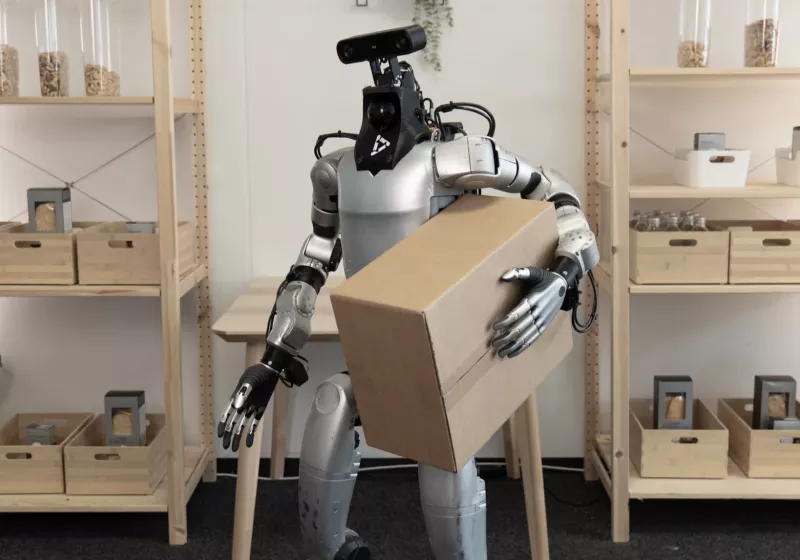
In a notable demonstration, a humanoid robot was tasked with retrieving a package, navigating stairs and an elevator, unpacking the contents, and organizing items into a drawer-all from a single command. The robot independently transitioned between walking, opening doors, and carrying objects, showcasing its ability to interpret and adapt to the task context without human intervention.
Reinforcement Learning: The Engine Behind Continuous Improvement
Reinforcement learning underpins the entire system, enabling the robot to enhance its performance through trial and error. According to Flexion’s cofounder and CEO Nikita Rudin, this approach is embedded throughout-from strategic planning to fine motor control-serving as the “secret sauce” that refines both decision-making and physical execution over time.
Shifting Focus: AI as the True Breakthrough in Robotics
While humanoid robots often captivate audiences with their human-like appearance, experts emphasize that the real innovation lies in their AI control systems. George Chowdhury of ABI Research highlights that the transformative potential is embedded in the software models driving these machines, not merely in their physical design.
ABI Research projects that foundational AI models for robotics could unlock a market worth $150 billion by 2036, underscoring the growing importance of adaptable software platforms in the robotics industry.
Flexion’s Strategy for Cross-Platform Compatibility
Flexion is positioning itself as a versatile AI provider, collaborating with various robotics manufacturers. Its system is engineered to function across diverse humanoid hardware platforms, a critical advantage given the wide variation in robot designs. This adaptability could be key to gaining traction in a fragmented market.
Challenges Ahead for Humanoid Robotics Adoption
Despite promising advances, the path to widespread humanoid robot deployment remains complex. Success will require close collaboration between AI developers and hardware manufacturers, as well as differentiation in an increasingly crowded field. More fundamentally, without robust systems capable of autonomously managing intricate, multi-step workflows, the humanoid robot market risks stagnation.
As Chowdhury bluntly states, “Without these capabilities, a viable market simply does not exist.”