Introducing Toshio Fukuda: A Visionary in Robotics
Toshio Fukuda stands as a towering figure in the robotics community, having authored over 2,000 scholarly articles and several authoritative books. His groundbreaking contributions span biomedical robotics, industrial automation, micro- and nano-robotics, mechatronics, and AI-powered systems, positioning him as a leading innovator in these fields.
Founding a Premier Robotics Conference
In 1988, Fukuda established the IEEE/RSJ International Conference on Intelligent Robots and Systems (IROS), which has grown into one of the most influential global gatherings for robotics researchers and practitioners, attracting upwards of 9,000 attendees annually. This conference remains a cornerstone event nearly four decades later, fostering collaboration and knowledge exchange worldwide.
Professional Roles and Academic Affiliations
- Current Position: Vice President of Research at Egypt-Japan University of Science and Technology (E-JUST), Alexandria
- Previous Roles: Professor Emeritus at Nagoya University, Japan; Visiting Professor at Nagoya University
- Academic Background: Bachelor’s from Waseda University; Master’s and Ph.D. from the University of Tokyo; Research at Yale University
- IEEE Status: Life Fellow
Leadership and Recognition in IEEE
Fukuda’s leadership within IEEE is historic-he served as IEEE president in 2020, becoming the first Asian to hold this prestigious role. His tenure coincided with the onset of the COVID-19 pandemic, during which he championed the expansion of IEEE’s online educational offerings, growing the IEEE Learning Network from a handful of courses to nearly 2,000 diverse learning resources today.
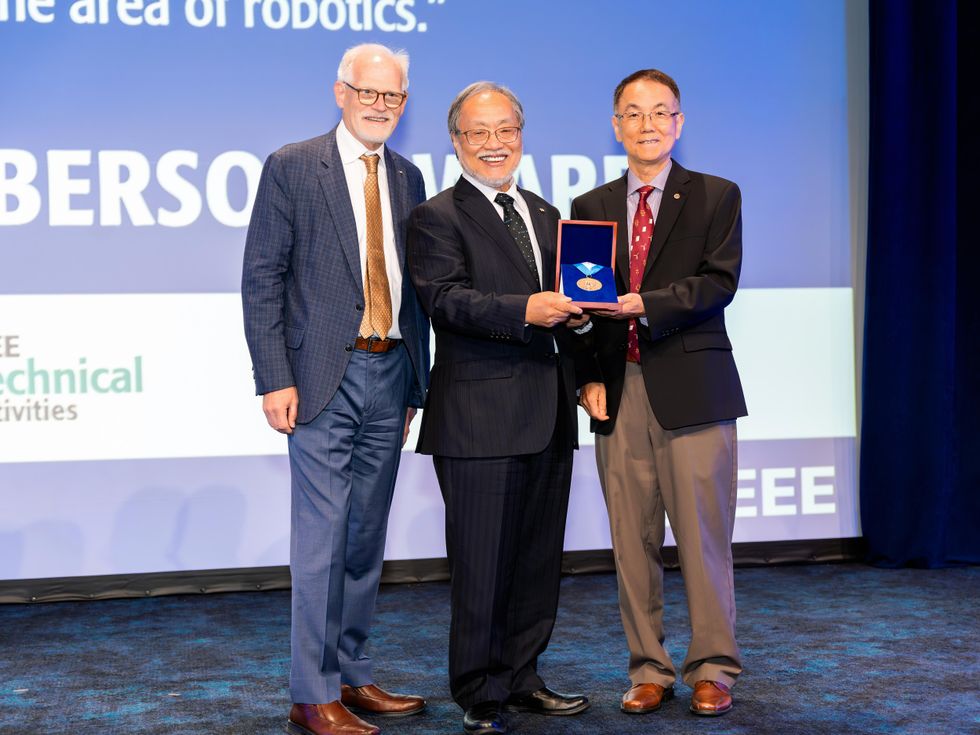
His dedication to advancing IEEE’s mission earned him the 2024 Richard M. Emberson Award, recognizing his exceptional service in promoting robotics technology and IEEE’s technical goals.
Early Inspirations and Academic Journey
From a young age, Fukuda was captivated by hands-on creation, building transistor radios and steam engines during summer breaks. This passion led him to pursue engineering, inspired by mentors like Ichiro Kato, a pioneer in Japanese robotics.
After completing his undergraduate studies at Waseda University in 1971, he earned advanced degrees at the University of Tokyo and conducted research at Yale University, where he delved into advanced control theory. His time at Yale fostered a spirit of intellectual freedom and curiosity that shaped his academic career.
Research Focus and Industrial Applications
Fukuda’s early research combined robotics with mechatronics, integrating electronics, computer science, and control systems. Returning to Japan, he worked at the National Institute of Advanced Industrial Science and Technology, focusing on practical robotics applications.
He later developed inspection robots designed for hazardous industrial environments such as oil refineries and power plants, securing funding from major chemical and utility companies due to the practical value of his innovations.
Innovations in Modular and Intelligent Robotics
Seeking new challenges, Fukuda pioneered modular robotic systems known as Cellular Robotic Systems (CEBOTs) in 1985. These systems consist of autonomous robotic units that connect and cooperate like interlocking building blocks, enabling flexible, fault-tolerant, and self-organizing robotic assemblies.
CEBOTs have since found diverse applications, including hospital medication delivery, agricultural assistance, and logistics automation, demonstrating the versatility of modular robotics in real-world scenarios.
Advancements in Micro-Nano Robotics and Brachiation Robots
During his 24 years at Nagoya University, Fukuda spearheaded research in micro- and nano-robotics, contributing to medical robotics and intelligent systems. Among his notable inventions are brachiation robots, inspired by the swinging motion of monkeys, which use pendulum-like locomotion to navigate complex structures.
These “monkey robots” are now employed in inspecting high-voltage transmission towers, conducting search-and-rescue operations in disaster zones, and maintaining pipelines, showcasing innovative approaches to robotic mobility.
Extensive Volunteer Contributions to IEEE
Joining IEEE in 1980, Fukuda quickly immersed himself in the organization’s activities, driven by a desire to understand conference organization and scholarly publishing. He founded IROS and helped launch the IEEE Transactions on Mechatronics in 1996.
He also served as the inaugural president of the IEEE Nanotechnology Council in 2002, reflecting his pioneering role in nanotechnology’s intersection with robotics. His leadership roles extended to IEEE Robotics and Automation Society presidency and multiple directorships within IEEE divisions and regions.
Commitment to Diversity, Equity, and Inclusion
As IEEE president, Fukuda prioritized creating an inclusive environment, spearheading initiatives to enhance diversity, equity, and inclusion (DEI) within the organization. He emphasized that IEEE values passion and energy above all else, welcoming members regardless of nationality, gender, or background.
Accolades and Legacy
Fukuda’s distinguished career has been recognized with numerous awards, including the IEEE Robotics and Automation Society’s Pioneer Award (2004), Saridis Leadership Award (2009), Harashima Award for Innovative Technologies (2011), and the IEEE Robotics and Automation Technical Field Award (2010).
His contributions continue to inspire the global robotics community, reflecting a lifelong dedication to advancing technology and fostering collaboration.