CRP Robot Technology Advances Toward Hong Kong Main Board Listing
Chengdu-based robotics innovator CRP Robot Technology has submitted an updated prospectus to the Hong Kong Stock Exchange as of May 31, aiming for a main board public offering. Guotai Haitong Securities serves as the exclusive sponsor for this listing endeavor.
Evolution from Component Supplier to Full-Scale Robotics Manufacturer
Established in 2012, CRP has developed a comprehensive lineup of proprietary robotics products spanning three main categories: industrial robots, collaborative robots, and embodied robots. According to market research by Frost & Sullivan cited in the company’s filing, CRP led the Chinese welding robot market by revenue in 2025. Between 2023 and 2025, CRP expanded its global footprint, delivering products to clients across 40 countries and regions, including key industrial hubs like Germany and Japan, and forging alliances with over 80 local integrators worldwide.
Initially concentrating on core robotics technologies, CRP primarily provided industrial robot controllers and electrical systems before 2018. That year marked a strategic shift as the company introduced its first fully assembled robot, moving beyond components to complete robotic solutions. In 2022, CRP further diversified by launching its inaugural embodied robot, designed for specialized industrial applications.
By May 2026, CRP’s industrial robot catalog featured over 70 models tailored for sectors such as metal fabrication, automotive manufacturing, electronics, renewable energy, consumer products, and healthcare. These robots perform critical tasks including welding, grinding, material handling, cutting, and adhesive application. The embodied robots address niche operations like transmission tower welding, solar panel installation, grain sampling, wood panel manipulation, and airport baggage handling.
Innovative Industrial Robots Designed for Complex Environments
In August 2025, CRP unveiled two advanced robotic systems: Lingshuo, a wheeled humanoid industrial robot, and Lingxun, a hybrid robot platform. Both integrate sophisticated environmental sensing, autonomous decision-making, and precise execution capabilities, enabling them to interpret complex tasks, adapt dynamically to changing conditions, and seamlessly collaborate with existing industrial machinery. These robots are engineered to meet the demands of cutting-edge manufacturing facilities.
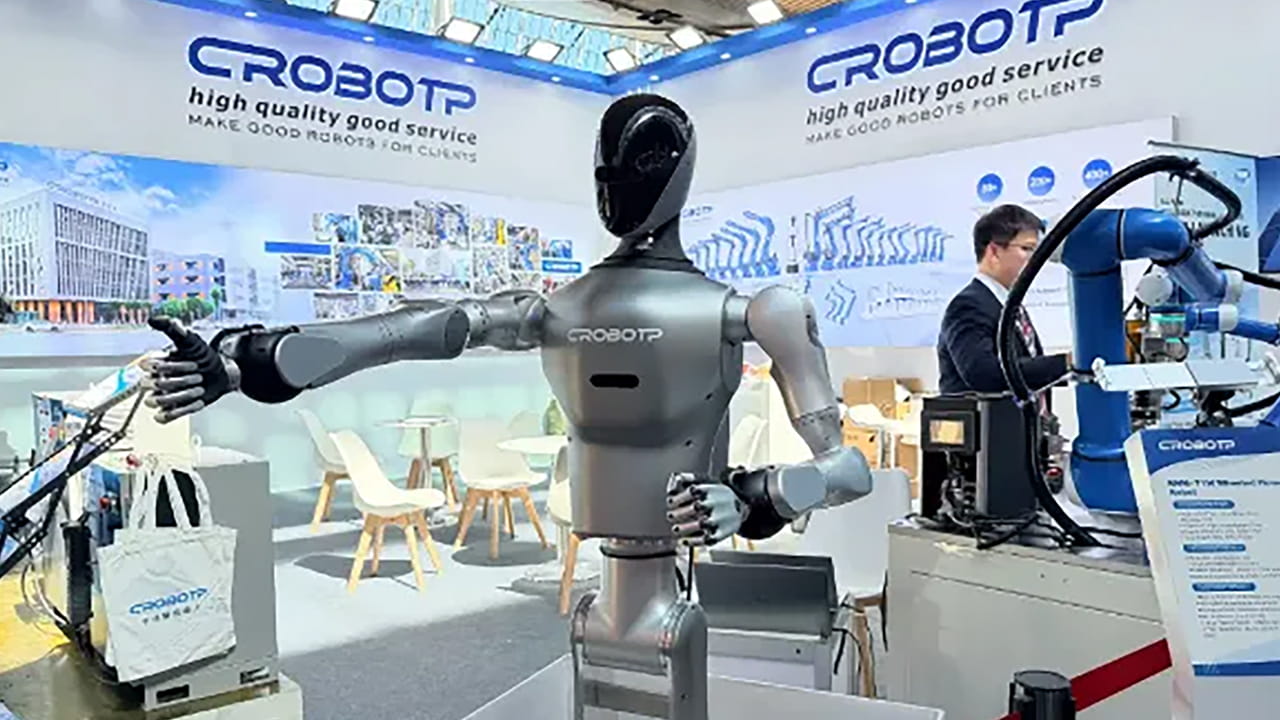
Earlier in March 2026, CRP showcased the RHM-T1W, its second-generation wheeled humanoid robot. This model combines a mobile wheeled base with a dexterous humanoid upper body, featuring autonomous obstacle avoidance, intelligent route planning, slope navigation, and sub-millimeter precision motion control. Its ability to perform intricate movements such as bending, turning, and grasping makes it ideal for challenging industrial roles including inspection, material handling, and assisted operations.
CRP’s proprietary robot intelligence system employs a dual-layer architecture: the foundational layer utilizes a 3D vision model to interpret complex industrial environments, while the upper layer leverages extensive knowledge bases encompassing over 70 industries and more than 2,000 process workflows. Enhanced by tactile feedback technology, this system optimizes robot performance for specialized industrial tasks.
By integrating perception, decision-making, execution, and iterative learning into a cohesive framework, CRP is advancing the capabilities of robots in industrial contexts. Its foray into embodied robotics builds upon established strengths in motion control, mechanical design, multisensor fusion, industrial scene analysis, and algorithm development.
Industrial Robotics: A Prime Market for Embodied Robot Commercialization
Industrial environments are widely recognized as the most promising early adopters of embodied robotics due to their standardized workflows, accessible data, clear economic benefits, and strong customer demand. CRP’s extensive experience, accumulated process data, and robust client relationships in industrial robotics position it well to capitalize on this emerging market segment.
As of May 2026, CRP held a portfolio of 326 patents and 44 software copyrights, reflecting over a decade of innovation across hardware, software, and algorithmic domains. This comprehensive intellectual property base underpins the company’s full-stack approach, which is critical in industrial robotics where robots function as integrated systems combining control units, software intelligence, mechanical components, and domain-specific expertise.
Mastery over the control layer grants CRP significant advantages in product iteration speed, cost efficiency, and adaptability to diverse industrial scenarios. This is particularly vital in welding applications, where precision motion control and deep process knowledge are essential for quality and reliability.
Robust Financial Growth and Strategic Expansion Ahead of IPO
CRP’s financial trajectory demonstrates accelerating growth, with revenues reaching RMB 222 million (approximately USD 32.7 million) in 2023, RMB 234 million (USD 34.5 million) in 2024, and RMB 324 million (USD 47.7 million) in 2025-a 38.5% year-over-year increase in the latest period. Notably, revenue from collaborative robots surged nearly fourfold in 2025, while embodied robot sales more than doubled, signaling a strategic shift toward higher-value product segments.
The company’s gross margin improved from 27.1% in 2023 to 33% in 2025, alongside a positive operating cash flow of RMB 28.3 million (USD 4.2 million) in 2025, highlighting enhanced operational efficiency and cash generation capabilities.
Since its inception, CRP has attracted investment from prominent venture capital and strategic partners, including Northern Light Venture Capital, Richen Capital, Shuanghuan Company, TTGG (Silicon Paradise), Eastern Bell Capital, Qixin Capital, Grand Yangtze Capital, HT Capital, and the Shanghai Electric Apparatus Research Institute (SEARI).
Proceeds from the upcoming IPO are earmarked for bolstering research and development, deepening collaborations with existing clients, expanding brand presence domestically, accelerating international market penetration, enhancing manufacturing infrastructure, and supporting general corporate operations and flexibility.