Yu Yinan: Pioneering the Future of Consumer Robotics
Yu Yinan has consistently anticipated emerging technological trends, positioning himself ahead of the curve. Rather than following the conventional academic path after completing his PhD, Yu ventured directly into China’s burgeoning internet industry. In 2015, when Yu Kai invited him to co-found a company focused on artificial intelligence chips, Yu became the inaugural employee of Horizon Robotics.
From Horizon Robotics to Vbot: A Vision for Consumer Robots
Under Yu’s leadership, Horizon Robotics evolved into one of China’s premier autonomous driving technology firms, culminating in a landmark IPO on the Hong Kong Stock Exchange in 2024-the largest that year. Later that year, Yu departed to establish Vbot, a startup dedicated to translating a decade’s worth of autonomous driving innovations into practical, consumer-friendly robots.
Yu’s leadership style blends technical expertise with pragmatic business acumen. At Horizon Robotics, he expanded his role beyond engineering to oversee supply chain, sales, and finance. This holistic approach continues at Vbot, where he manages all facets of the enterprise with decisive discipline.
Vbot’s Early Successes and Market Entry
Vbot has rapidly achieved significant milestones. The company recently closed a pre-Series A funding round, securing approximately RMB 500 million (USD 73.4 million). This round was led by Orient Renaissance Capital, Huatai Zijin Investment, and Fosun RZ Capital, with additional backing from SAIC-backed Shang Qi Capital, Mornway Capital, and returning investors such as Cathay Capital and Baidu Ventures.
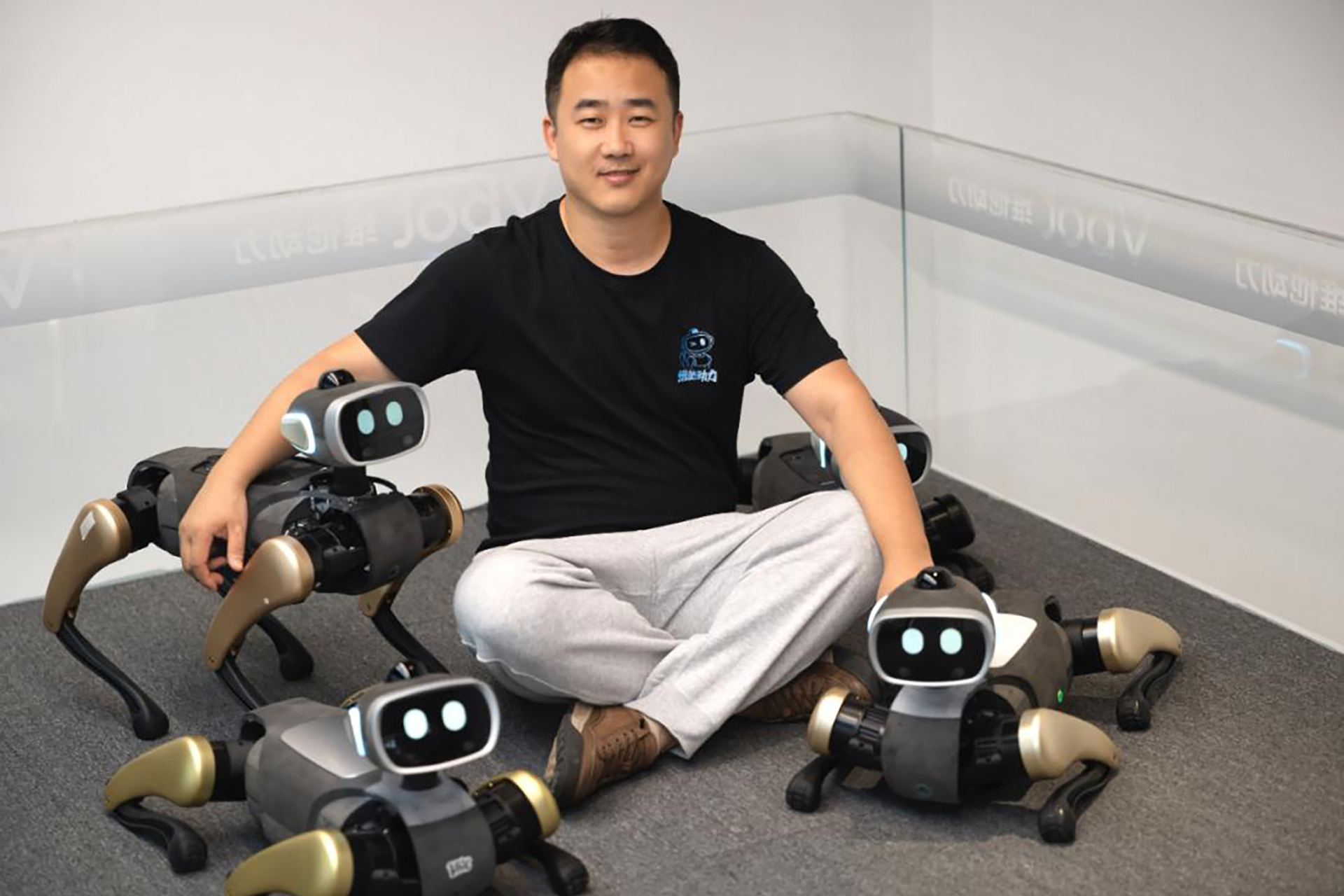
Mass production of Vbot’s flagship quadruped robot commenced on May 8, with the first 500 units delivered to customers. Alongside this, Vbot is actively developing humanoid robots, aiming to broaden its product portfolio. The company anticipates fulfilling orders for over 1,500 units in May, with production capacity expected to exceed 2,500 units monthly by June, accelerating delivery to pre-order customers.
Expanding Consumer Reach Through Offline Channels
In addition to scaling production, Vbot is establishing a physical presence through offline experience centers. Initial stores have opened in prominent locations such as Raffles City Changning in Shanghai and Solana in Beijing. Plans are underway to expand into major retail outlets nationwide, including JD Mall and Sam’s Club, enhancing consumer accessibility and engagement.
Industry Outlook: Practical Home Robots by 2027
Yu envisions the arrival of home robots with tangible utility by 2027, marking a pivotal moment for embodied intelligence. However, he tempers expectations, emphasizing that the field remains in its infancy with ongoing evolution in product design, technical approaches, and application scenarios. Vbot’s strategy prioritizes rapid iteration, launching a “60-point” product initially and refining it through continuous user feedback rather than waiting to perfect a “100-point” solution.
Strategic Focus Areas for Vbot’s Next Phase
Looking ahead, Vbot is concentrating on three core research and development domains:
- Designing full-size humanoid robots that integrate advanced mobility and task execution capabilities.
- Developing comprehensive world models to enable general manipulation and autonomous navigation.
- Creating an embodied intelligence operating system based on an agentic OS framework to support diverse robotics applications across homes, commercial venues, and offices.
Insights from Vbot Leadership
Order Volume and Production Capacity
Zhao Zhelun, Co-founder of Vbot: “Since launch, we have received over 8,000 orders for our quadruped robot. Collaborating with Huaqin, we established a dedicated production line and are currently scaling up. Approximately 500 units have been produced, with plans to deliver 1,500 units in May and increase monthly output to 2,500 units by June. At full capacity, we expect to exceed 4,000 units per month.”
Customer Demographics and Purchase Motivations
Zhao Zhelun: “Our customers largely mirror the profile of new energy vehicle owners aged 30 to 45, predominantly middle-class families with children. They own brands such as Li Auto, Nio, Tesla, Mercedes-Benz, BMW, Audi, and Porsche. The primary driver for purchasing our robot is family companionship, followed by the appeal of introducing children to cutting-edge AI technology. Additionally, the ability to take the quadruped robot outdoors distinguishes it as a unique embodied intelligence product. Currently, all orders originate from within China.”
Challenges in Consumer Robotics and Solutions
Zhao Zhelun: “Consumer markets demand higher standards for product quality, reliability, and user experience compared to enterprise clients, yet the robotics supply chain remains immature. We have adopted automotive-grade standards for our quadruped robot and addressed three key system challenges:
- Mechanical Durability: Enhanced joint motor and body durability to ensure quiet, consistent operation over 500-1,000 kilometers without gear looseness.
- Energy Efficiency: Redesigned electrical architecture to replace industrial battery swapping with a larger integrated battery, achieving five hours of continuous use.
- Intelligent Autonomy: Integrated autonomous driving-grade computing and sensors to enable independent operation without remote control.
Data-Driven Iteration and Model Evolution
Yu Yinan: “Our approach involves two stages: first, launching a market-ready product with essential capabilities; second, developing a self-learning system that improves through real-world use. Robots operating in diverse environments generate valuable boundary data-instances near success or failure-that we filter on-device and upload for cloud-based processing. This data trains improved models, which are then deployed via over-the-air updates, fostering continuous enhancement.”
Data Quality and Quantity for Scaling
Yu Yinan: “We prioritize data that is both high-quality-capturing critical success or failure points-and highly diverse, reflecting varied real-world scenarios. Repetitive or irrelevant data offers little value. Industry consensus suggests that achieving robust generalization requires millions of hours of diverse data, emphasizing quality over sheer volume.”
The Quadruped Robot as a Transitional Platform
Yu Yinan: “A fully embodied intelligent agent must combine interaction, mobility, and manipulation, with form factors tailored to specific environments. Industrial robots often suffice as fixed arms, while commercial service robots focus on human interaction. Home environments are the most complex, requiring adaptability to stairs, carpets, and furniture. The quadruped robot is a practical entry point for homes, but more sophisticated household tasks will eventually necessitate humanoid designs. Our strategy involves building a modular robotics operating system and core components adaptable to various forms, with the home market as our initial focus.”
Leveraging Simulation and Real-World Testing
Zhao Zhelun: “Simulation plays a vital role in validating algorithms and gait before hardware development. However, it cannot fully replace physical testing. For example, a component simulated to withstand 1,000 kilograms failed in reality due to manufacturing defects like internal air bubbles. Material properties and production processes remain blind spots for simulation, necessitating iterative prototyping.”
Market Timing and Industry Momentum
Yu Yinan: “The home is the largest potential market for robotics. Recent breakthroughs in world models, motion control, and dexterous manipulation have made practical home robots feasible. We anticipate meaningful home robot deployments by 2027, transitioning from demonstrations to reliable, high-quality service providers. As robots handle increasingly complex tasks, the market will grow exponentially.”
Competitive Landscape and Differentiation
Yu Yinan: “Competition unfolds in stages. Initially, speed to market-rapid R&D, production, and user acquisition-is critical. Over time, deeper technical advantages such as patent portfolios, brand reputation, product quality, and user loyalty will define market leaders by raising switching costs.”
Synergies Between Quadruped and Humanoid Robots
Yu Yinan: “There is significant overlap between quadruped and humanoid robots. More than half of the hardware components-including joints, computing platforms, batteries, sensors, and materials-are interchangeable. Software elements like operating systems, electronic architectures, and communication protocols are nearly identical. Algorithmic components, especially higher-level models, are highly reusable. The primary difference lies in low-level motion control, which must be customized to each robot’s physical form, akin to adapting one intelligence system to different bodies.”
Upcoming R&D Priorities
Yu Yinan: “Our immediate focus areas include developing full-size humanoid robot bodies that integrate mobility and task execution, creating a unified world model for manipulation and locomotion, and building an embodied intelligence operating system based on an agentic architecture. This will enable a versatile robotics ecosystem serving homes, commercial spaces, and offices.”
Impact of Tesla’s Third-Generation Humanoid Robot
Yu Yinan: “Tesla’s mass production of its third-generation humanoid robot will be a landmark event, much like the Model 3’s entry into China. It will educate the market, unify industry expectations, and establish a playbook for success. Rather than disrupting existing players, it will accelerate the entire ecosystem, attracting capital and talent, similar to Tesla’s influence on Chinese electric vehicle companies like Nio and Xpeng.”
Industry Outlook Amidst Skepticism
Yu Yinan: “Despite recurring claims of a robotics bubble and impending market cool-down, we believe embodied intelligence is only beginning its journey. The industry remains highly dynamic and far from maturity. Recent IPOs in robotics and large AI models will attract more investment, fostering a vibrant ecosystem rather than draining capital.”