Vision of Hope: Mozambican Student builds smart glasses to guide blind –
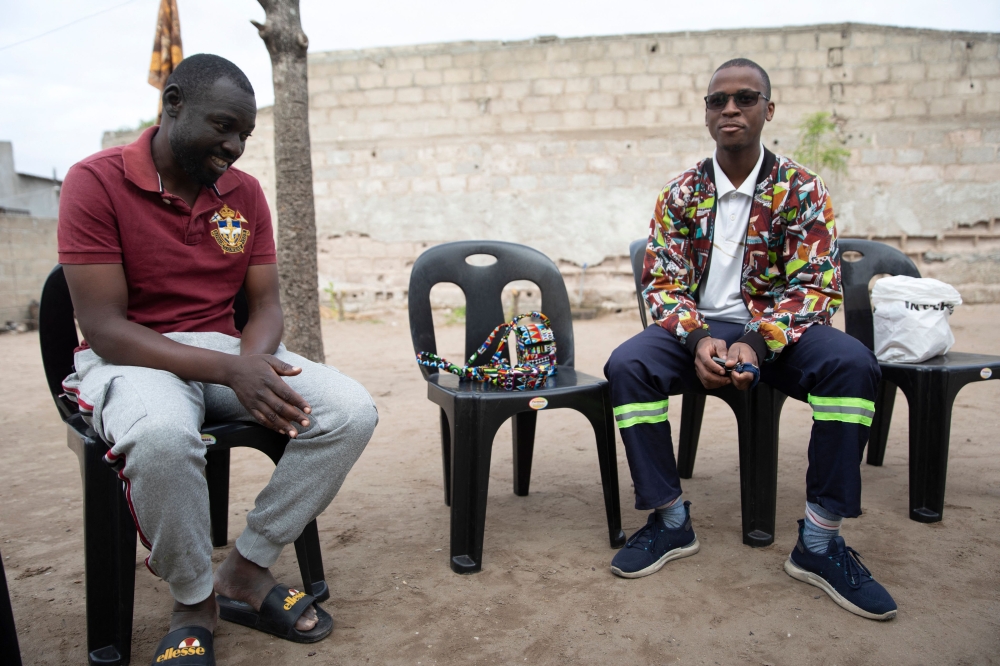
Mozambican Armando Ernesto Chau, who is blind, sits in front of a pair smart glasses invented by Joao Antonio rego (right), a 24 year old robotics student. This was taken on June 14, 2025 at home in Matola. This is the latest prototype in a series of models that Rego has been developing since he launched his Vision Hope project back in 2021. Rego won Mozambique’s Young Creative Award in the following year for technological innovation. The device is similar to a virtual reality mask, and it has sensors that scan for obstructions. The intensity of vibrations increases as an object gets closer. — AFP pic (#19659003) Planning your holiday getaways? Invest RM100 in
Start your travel fund with Versa and FREE RM10 . Use Versamm10 right now!
Sunday 29 Jun 2025, 5:20 PM MYT.
Maputo, June 29 — As Armando Ernesto Chan straps on his futuristic smart glasses, which a young Mozambican student of robotics is developing in the dining room of the family home, he sees a future where he will not be confined to the confines of his modest home.
Chau, a 24-year old student of robotics and electronics engineering, is the prototype tester. Rego’s goal is to provide Mozambicans who are visually impaired with more than a cane.
The 45-year-old father, who lost his vision 20 years ago, has not worked since and rarely leaves Matola outside Maputo. Rego’s electronic sunglasses — battery-powered devices embedded in sensors that scan ahead for obstacles and emit warning vibrations – offer new possibilities. Chau demonstrated Rego’s Vision Hope 0.2 to AFP. “It vibrates… those bushes,” Chau explained. “Maybe there is a small window here… yes.”
“Because of the obstacles, it vibrates.” “I’m going back,” he said. “It stopped. See? Then it says that there is something on the other side… When I turn it is quiet.”
This prototype, which resembles a virtual reality mask, is Rego’s latest since he launched Vision Hope in 2021. He won Mozambique’s Young Creative Award for technology innovation the following year. Rego, an Eduardo Mondlane University student, said that the new features include a 120-degree range with more accurate sensors.
A battery attached to a strap worn over the shoulder is part of a smart system which conserves power and alerts users when it runs low. A GPS lets others know where the user is.
Prototypes of smart glasses invented by 24 year old robotics student Joao Antoni Rego (right) on display at his Matola home June 14, 2025. AFP pic —
Inspiration.
Rego has already begun working on improvements to his dining room workshop.
I want the next version of the sensor to be able to detect very thin obstacles such as wires and threads,” he said. “The coating must also be waterproof,” he added.
Rego, who is slim and serious, was inspired to assist when he saw, years ago, an elderly woman with a visual impairment fall in a busy Maputo street, according to his mother Helena Inacio.
He was disturbed by the sight of that woman lying on the ground. She told AFP that he had promised to create glasses.
The woman had asked, “What are glasses for? So that blind people could see?’ He replied, “No, to give directions.”
Inacio said, “I thought it would be fantasy.”
Rego relocated his lab from his bedroom to a better location for ventilation, after a doctor warned him about the dangers of fumes emitted by his soldering.
I had health issues and after an X ray, they found spots on my lungs that could have been caused from chemical fumes like tin. He said that although it was temporary, he must always be cautious.
Independence
— AFP pic
Chau has some suggestions for the new version. He lost his vision in 2005 after falling ill and being treated in hospital.
I told him to improve the roadside system first, he said. He also wants a sensor to detect the pools of water that are prevalent in his area.
If possible, an identification system for obstacles detected would be helpful. “A system which communicates… what type of obstacle is in my path, whether it is a person, a vehicle,” he said.
Chau said, “If the glasses were made in the way I suggested, it would help me and many visually impaired people around the world.”
Once they are in production, and Chau can get his own set, the glasses will give Chau new life, according to his wife, Felizarda Nhampule.
Sometimes he stays at home while I run my errands. She said that sometimes he wants to leave the house but is unable to do so.
With the glasses, he can visit his friends to get rid of the boredom that comes with staying at home. She told AFP that he could go to his neighbours for help in an emergency.
These glasses will be of great help to him as well as to us, his family.” — ETX Studio.